Updated: July 2026
Luxury Komodo Phinisi vs. Yacht: Which is Better for You?
- For Authenticity & Space: Choose a Phinisi.
- For Speed & Technology: Choose a Superyacht.
- For Immersive Journeys: The Phinisi’s slower pace is a distinct advantage.
The first light of dawn spills across the Flores Sea, turning the water from indigo to liquid gold. From the bow, the silhouette of Padar Island materializes, its jagged peaks a prehistoric spine against the brightening sky. The air is thick with the scent of salt and the distant, earthy aroma of the savannah. A gentle creak of timber underfoot is the only sound, a rhythmic counterpoint to the soft lapping of waves against the hull. You are here, Komodo National Park, and the vessel carrying you is not just a mode of transport; it is the very lens through which you will experience this primal world. The critical question for the discerning traveler is, what form should that lens take? Should it be the handcrafted soul of a traditional Phinisi, or the sleek, powerful form of a modern superyacht? The answer will define your entire journey.
The Soul of the Archipelago: Understanding the Phinisi Legacy
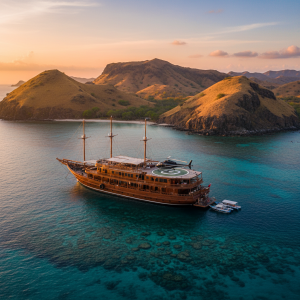
To step aboard a Phinisi is to step into a living narrative. These are not merely boats; they are the seafaring legacy of the Konjo people of South Sulawesi, a tradition of shipbuilding so profound it was inscribed on UNESCO’s list of Intangible Cultural Heritages in 2017. Historically, these two-masted schooners, with their seven iconic sails, were the cargo workhorses of the Indonesian archipelago, carrying spices and goods across the 17,000 islands. Today, they have been reborn. The modern luxury Phinisi is an extraordinary fusion of ancient craftsmanship and contemporary comfort. Built by hand from locally sourced ironwood and teak, their construction can take over 18 months and involve generations of familial knowledge. Yet, within these traditional hulls lie amenities that rival the finest boutique hotels: climate-controlled suites with panoramic windows, marble-clad ensuite bathrooms, and professional-grade galleys. I recall speaking with naval architect Antoine De La Roche, who specializes in these modern conversions. “A Phinisi moves through the water with a different spirit,” he noted. “The sheer weight and displacement of the timber hull provide a foundational stability that fiberglass can’t replicate. It’s a gentler, more connected way to sail.” Vessels like the 55-meter Prana by Atzaró or the elegant Dunia Baru can host up to 18 guests, offering over 400 square meters of usable deck space for everything from morning yoga to astronomical observation.
The Gleam of Modernity: The Case for a Superyacht
Where the Phinisi speaks of heritage, the modern superyacht proclaims performance. These vessels are marvels of naval engineering, characterized by their hydrodynamic composite or steel hulls, powerful engines, and a profile that prizes speed and efficiency. For the traveler whose time is the ultimate luxury, this is a compelling proposition. A state-of-the-art motor yacht can cruise comfortably at 15 knots, nearly double the leisurely 8-knot pace of a traditional Phinisi. This capability fundamentally alters the scope of an itinerary. A one-week charter could feasibly include the volcanic landscapes of Mount Tambora on Sumbawa, the pristine reefs of Alor, and the dragon-inhabited shores of Komodo—a geographical range a Phinisi would need nearly twice as long to cover. The technological superiority extends to the onboard experience. Zero-speed stabilizers are now standard on most yachts over 30 meters, creating a remarkably placid environment at anchor, virtually eliminating any roll from waves or swell. The toy garage is another key differentiator. While Phinisis carry tenders and paddleboards, a superyacht is a platform for high-adrenaline water sports: jet skis, Seabobs, Fliteboards, and even personal submarines are common features. The interior is a controlled environment of perfect luxury, often penned by world-renowned designers, offering a consistent five-star experience from the Caribbean to Komodo.
Onboard Experience: Ambiance and Social Spaces
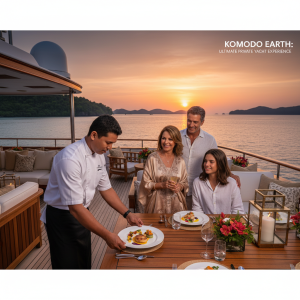
The choice between a luxury Komodo phinisi vs yacht profoundly shapes the social dynamic and atmosphere of your voyage. A Phinisi is designed for life in the open air. Its defining feature is the sheer expanse of its decks. The main deck often serves as a vast, shaded al fresco living room and dining area, becoming the natural heart of the vessel. Days are spent moving between shaded daybeds, sun-drenched loungers, and the bowsprit net, with the 360-degree panorama of the archipelago as constant wallpaper. The experience is communal and connected to the elements. You feel the shift in the breeze; you hear the call of a sea eagle. It fosters a relaxed, barefoot-luxury ambiance that is deeply tied to the location. A motor yacht, by contrast, offers a more curated and compartmentalized experience. Life is often divided between several distinct areas: a formal, air-conditioned main salon, a more casual sky lounge, a sun deck with a jacuzzi, and a shaded aft deck for dining. This separation allows for more private, individual moments and offers respite from the tropical heat. It’s an environment of precise, climate-controlled comfort. The choice here is philosophical: Do you want a floating villa that insulates you with familiar luxury, or a handcrafted stage that immerses you in the spectacular drama of the Indonesian seascape? This very decision is at the core of planning the perfect private Phinisi yacht voyage.
Itinerary and Exploration: Pace vs. Power
How you explore Komodo National Park—a protected area spanning 1,733 square kilometers of land and sea—is directly dictated by your vessel’s capabilities. With a Phinisi, the journey itself is a primary part of the destination. The slower pace is a feature, not a limitation. It allows for a deeper, more meditative immersion into the rhythm of the islands. You might spend an entire morning watching a pod of dolphins play off the bow, or anchor in a secluded cove inaccessible to larger ships, simply because you have the time. The focus is on saturation, not distance. A typical seven-day Phinisi charter would deeply into the park’s core, exploring the iconic viewpoints of Padar, the rare pink sands of Pantai Merah, and the world-class dive site of Batu Bolong, all at a pace that feels unhurried and organic. A superyacht’s power, however, unlocks a different kind of freedom—the freedom of range. Its speed allows you to treat the park as one fantastic stop on a broader “greatest hits” tour of the Lesser Sunda Islands. You can wake up for a sunrise trek with Komodo dragons, lunch while cruising at 14 knots, and be snorkeling over the pristine reefs of North Flores by late afternoon. For guests with a checklist of experiences and a limited timeframe, a yacht is an tool of efficiency, maximizing the number of unique locations visited. The question is whether you prefer to savor one region or sample many.
Crew, Culture, and Cuisine
Beyond the hardware of the vessel lies its soul: the crew. This is where the distinction between the two charter styles becomes most personal. The crew of a luxury Phinisi is almost invariably Indonesian, often hailing from the very maritime communities that have sailed these waters for centuries. Your captain might have learned navigation from his father, not a classroom, and possesses an intuitive understanding of the local currents and winds. This creates an opportunity for genuine cultural exchange. The service is warm, heartfelt, and deeply personal, offering an authentic window into Indonesian hospitality. The culinary program is a direct reflection of this. A chef on a Phinisi like Lamima will craft menus around the day’s catch and fresh produce from local island markets, presenting elevated Indonesian specialties like Pepes Ikan or a rich Beef Rendang alongside international favorites. Conversely, a superyacht crew is typically international, trained to a meticulous, uniform standard of service that is the same in Monaco as it is in Komodo. The professionalism is flawless and discreet, but the connection to the local culture is less innate. The galley is often run by a Michelin-star-trained chef capable of producing complex European gastronomy in the most remote of locations. For many, the deep, authentic connection offered by a local crew is the defining element of a true komodo luxury charter.
Quick FAQ: Luxury Komodo Phinisi vs Yacht
Are Phinisis as safe and comfortable as modern yachts?
Absolutely. Modern luxury Phinisis are built to stringent international safety standards (such as SOLAS) and are classified by maritime bodies like RINA or Bureau Veritas. They are equipped with modern navigation and communication systems, and many feature hydraulic stabilizers to ensure comfort both underway and at anchor. The primary difference is in the materials and design philosophy, not in safety or core comforts like air conditioning and water makers.
What is the typical cost difference?
For vessels of a similar size and level of luxury, the weekly charter rates are surprisingly comparable. A high-end 5-cabin Phinisi and a 40-meter motor yacht might both fall within the $50,000 to $100,000 per week range, plus expenses. The value proposition is simply different. With a Phinisi, you are paying for the craftsmanship, cultural heritage, and immense space. With a yacht, the premium is for speed, technology, and brand-name designers. According to industry data, operational costs can be slightly higher for high-performance motor yachts due to fuel consumption.
Can I still enjoy water sports on a Phinisi?
Yes, though the focus may differ. Every luxury Phinisi is equipped with tenders for diving and shore excursions, as well as a host of non-motorized toys like kayaks, stand-up paddleboards, and snorkeling gear. The emphasis is on silent, human-powered exploration that aligns with the vessel’s tranquil ethos. While some may carry a jet ski, it is less common, partly due to park regulations promoted by tourism authorities like Indonesia Travel and the desire to maintain a peaceful environment.
Ultimately, there is no single “better” vessel. The choice between a Phinisi and a superyacht is a reflection of your personal travel philosophy. Are you seeking a journey that is deeply woven into the cultural and historical fabric of your destination, a slow and immersive discovery of place? Or do you desire a fast-paced, technologically advanced platform to see and do as much as possible in ultimate comfort? One offers a story, the other, efficiency. The right vessel is the key that unlocks the archipelago in a way that is meaningful to you. To find yours, and to begin crafting an itinerary that speaks to your personal sense of discovery, we invite you to explore our curated portfolio at the Komodo Luxury Charter Atelier.